

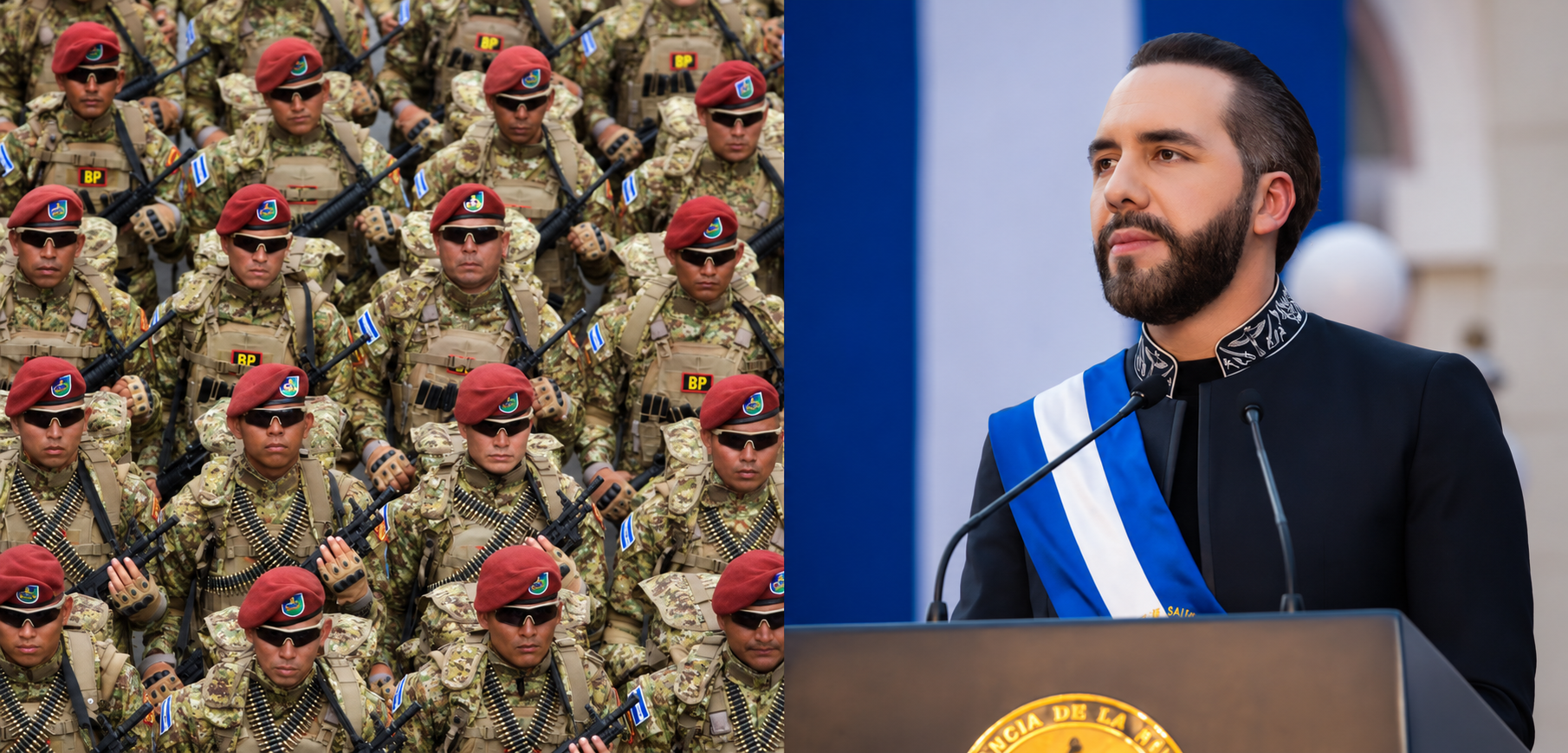
Thousands of Haitians marched through Port-au-Prince on Nov. 17 to thank Salvadoran President Nayib Bukele and his soldiers. Some in the crowd shouted, “Bukele is here to free us!” Within weeks of arriving, Salvadoran troops and Haitian forces had retaken ground that gangs still held more than a year after the UN Security Council authorized its Gang Suppression Force (GSF).
Bukele sent troops after gangs ambushed four Salvadoran military aviation technicians on Oct. 18. The four men remain missing. By Nov. 9, El Salvador had deployed roughly 2,500 soldiers, more than the entire UN-authorized Gang Suppression Force had on the ground when the Security Council renewed its mandate in late September. At that point, the GSF had about 1,500 personnel in Haiti despite pledges of up to 7,500.
The UN’s earlier 13-year peacekeeping mission in Haiti cost more than $7 billion. The General Assembly committed another $271 million for a support office for the new force before most of its troops had arrived. After billions in UN spending, gangs still controlled parts of the capital, including the national stadium.
Salvadoran troops were more effective because they fought the gangs and held the ground they retook, showing once again that success was a choice and that the UN had apparently chosen failure.
In September, a Sri Lankan unit with the UN-backed force killed three gang members in the Artibonite, stayed a few hours and returned to base. Gang members then killed at least 11 residents in retaliation. Salvadoran troops destroyed the headquarters of the 400 Mawozo gang and, alongside Haitian forces, retook the national stadium. The Salvadorans stayed and turned the stadium into a base. Bukele had the political will that the governments backing the UN-authorized force lacked.
The Security Council created the GSF on Sept. 30, 2025, through Resolution 2793, adopted under Chapter VII of the UN Charter. The UN established a support office, and participating countries volunteered personnel. The resolution set a ceiling of 5,500 uniformed military and police personnel and 50 civilians. It authorized intelligence-led counter-gang operations, either independently or alongside the Haitian National Police and the Haitian Armed Forces. It also gave the force the power to detain suspected gang members, a power the previous Kenya-led mission lacked.
At the vote, U.S. Ambassador Mike Waltz said that “due to the lack of true burden sharing, the international community had failed to deliver a mission that was fit for purpose,” according to the official record.
The Kenya-led mission that came before the current force illustrated the UN’s lack of commitment and effectiveness while underscoring the waste. The mission had an authorized strength of 2,500 personnel, but even at its peak it deployed fewer than 1,000 officers. In March 2025, Kenya’s police spokesman said, “The government of Kenya is not financing the MSS Mission to Haiti. The mission is 100 percent funded by the United Nations (UN) Trust Fund.”
The UN’s troubled history in Haiti goes back to 2010, when sewage from a camp housing Nepali UN peacekeepers contaminated a river system, triggering a cholera outbreak that killed more than 9,300 people. Secretary-General Ban Ki-moon apologized in 2016, more than six years after the outbreak began, saying the UN was “profoundly sorry” for its role.
In December 2025, Secretary of State Marco Rubio said the United States had received pledges of up to 7,500 personnel, above the force’s authorized ceiling of 5,500 uniformed personnel. The first contingent, an advance team from Chad, reached Haiti on April 1, six months after the resolution passed. That month, GSF chief Jack Christofides told the Security Council that troop pledges had exceeded expectations.
When the Security Council met on Sept. 29, 2026, Waltz said about 1,500 GSF personnel were deployed, about 27 percent of the authorized uniformed strength. The Council extended the mandate to March 31, 2027, through Resolution 2829. “Seven missions have been dedicated to Haiti over the previous decades and obviously to limited success,” Waltz said.
The UN-authorized force took six months to get its first contingent to Haiti. By contrast, Bukele sent Salvadoran special forces within days of the Oct. 18 ambush. He had deployed 2,000 troops by the end of October, and the number had risen to 2,500 by Nov. 9. Most operated outside the Gang Suppression Force. UN spokesman Stéphane Dujarric said only about 200 Salvadoran soldiers fell under its jurisdiction.
On Nov. 10, Haiti’s prime minister praised Bukele after Salvadoran troops helped destroy a house believed to belong to a powerful gang leader. Two days later, Haitian and Salvadoran forces retook the Sylvio Cator Stadium, Haiti’s national stadium, which gangs had held for more than two years. The occupation had forced Haiti to play its World Cup qualifiers away from home. Salvadoran soldiers now guard the stadium, and Bukele said they would use it as a base for operations in gang-held territory.
Haitian Security Minister Patrick Pélissier traveled to San Salvador and said, “The Haitian people applaud the decision of Nayib Bukele to send troops.” He added that Haitian authorities were considering asking El Salvador to extend the mission. At the march, demonstrator Maxseau Lomba said gangs had burned houses and killed children and pregnant women. “We say thank you to our father, Bukele,” he said.
Salvadoran Vice President Félix Ulloa and Security Minister Gustavo Villatoro have said the soldiers will return home once the four missing technicians are found.
Bukele has said repeatedly, particularly when criticizing the spread of cartel control in Mexico, that no gang is more powerful than any country’s army. His deployment to Haiti demonstrated that even the army of a small country like El Salvador, backed by a president determined to succeed, can take on gangs and accomplish more in weeks than the UN accomplished in more than a decade.
The post Bukele’s Deployment of the Salvadoran Army Proved the UN’s Multibillion-Dollar Failure in Haiti Was a Choice appeared first on The Gateway Pundit.