


Every week, the GoldCare HealthDesk receives questions from readers looking for answers about their health. Our team selects two from the many submissions for Dr. Simone Gold to answer, offering clear medical insight, practical guidance, and the straight talk she’s known for.
Question:
My husband is retired USN and has Parkinsons. Had it for 8 years. He is losing weight. He’s 165 lbs. and 6’2”. Doctors don’t seem to be concerned. What can I give him to put some weight on? Thanks, Patty Horne
Dr. Gold:
First, please thank your husband for his service to our country. We want to help him stay as strong and healthy as possible.
Weight loss is common in Parkinson’s disease, but that doesn’t mean we should ignore it. At 6’2″ and 165 pounds, your husband is still within the healthy weight range, with a BMI of about 21.2. But what concerns me is whether he keeps losing weight. Over time, that can lead to muscle loss, weakness, and frailty.
So why does Parkinson’s make it difficult to maintain weight?
Tremors, muscle stiffness, and involuntary movements can make the body burn more calories, even at rest. At the same time, a reduced sense of smell or taste, depression, and nausea from medications can make eating less appealing.
Parkinson’s can also slow digestion, causing constipation, bloating, and feeling full after eating very little. Some patients develop swallowing difficulties.
In other words, your husband may be burning more calories while eating less.
First, ask his doctors to investigate other possible causes of weight loss, including thyroid problems, digestive disorders, depression, and medication side effects. Parkinson’s may not be the only factor.
A thorough medication review is essential as many drugs can adversely affect the appetite.
If he coughs during meals, has difficulty swallowing, or feels food getting stuck, ask for a swallowing assessment. A speech-language pathologist can recommend safer food textures if necessary.
Your goal is to increase his calorie intake, but we want foods that also help preserve muscle, support energy production, and provide the nutrients his body needs.
What can help him gain weight?
- Add more healthy fats. Fat provides more than twice as many calories per gram as protein or carbohydrates, making it ideal when appetite is poor. Try avocado, extra-virgin olive oil, nuts, and nut butters such as almond, peanut, or macadamia. Coconut oil, butter, full-fat yogurt, and cheese can also add calories if tolerated. Just one avocado or a couple of tablespoons of oil or nut butter can provide 200 calories or more. Favor olive oil, avocados, nuts, and fatty fish for their additional heart-health benefits.
- Choose nutrient-rich whole foods. Focus on foods that provide vitamins, minerals, protein, and healthy fats along with calories. Limit ultra-processed foods and excess added sugar. You can use extra-virgin olive oil, coconut oil, beef tallow, or avocado oil instead of seed oils. Note that most grocery store olive oil is likely to be adulterated with seed oils, and the same holds for avocado oil.
- Make protein a priority, but watch the timing. Eggs, salmon, grass-fed or pasture-raised meats, full-fat Greek yogurt, and cheese can help preserve muscle.
- Try high-calorie smoothies. Blend full-fat milk or coconut milk with avocado, nut butter, berries, and unflavored protein powder if needed. This provides plenty of calories without requiring a large meal. Collagen can also add protein, but it shouldn’t replace complete protein sources needed for muscle maintenance. Add full-fat ice cream or Greek yogurt, and throw in a raw (pastured) egg for complete protein and vitamins A, D, E, and K. Carbohydrates stimulate insulin release, which is necessary for weight gain.
- Offer smaller, more frequent meals. Instead of three large meals, try smaller portions or snacks every two or three hours. This can help when slow digestion causes early fullness. Keep nuts, cheese, yogurt, and other favorite foods readily available. Adding olive oil to vegetables or meat is another easy way to increase calories.
- Make food more appealing. Parkinson’s can dull the senses of smell and taste. Herbs, spices, and flavorful seasonings may help encourage him to eat more. Salt food liberally.
- Address constipation. Slow digestion can cause bloating and reduce appetite. Fiber from tolerated fruits, vegetables, and other whole foods, along with adequate hydration, can help. Certain forms of magnesium may also relieve constipation when appropriate. Improving digestion can make eating more comfortable.
- Resistance training is important to stimulate muscle and bone.
Could a ketogenic diet help?
Researchers are increasingly interested in how Parkinson’s affects the brain’s ability to produce energy.
Much of that energy comes from mitochondria, the tiny structures that act as power plants inside our cells. Problems with mitochondrial function, inflammation, and oxidative stress may contribute to Parkinson’s. Ketogenic diets cause the body to produce ketones, an alternative fuel the brain can use instead of glucose.
Some studies have shown improvements in some Parkinson’s symptoms, including fatigue, mood, thinking difficulties, and certain movement problems. But strict ketogenic diets often suppress appetite and cause weight loss. That’s the opposite of what your husband needs right now. Ketone supplements may be beneficial.
At this point, I’d focus on increasing calories through nutritious whole foods and healthy fats before anything else.
What should you do next?
I’d recommend working with a registered dietitian experienced in neurological conditions. You can find one through GoldCare. A dietitian can help him increase calories and protein while accounting for his medications and digestive symptoms.
Weigh him once a week under similar conditions to see whether he’s making progress. Next generation bathroom scales are available that use bioimpedance to assess lean body mass (muscle) and fat mass. This is important information.
With the right nutrition, meal timing, and medical support, there’s a good chance we can help him maintain his weight and preserve his strength.
Question:
Is there anything new for the diagnosis and treatment of tinnitus?
Dr. Gold:
Tinnitus can be incredibly frustrating. That constant ringing, buzzing, or humming in your ears can make it difficult to concentrate, relax, or get a good night’s sleep.
The good news is that we’re learning more about what causes tinnitus, and there are some promising treatments that weren’t available just a few years ago.
What’s actually causing the ringing?
Tinnitus isn’t a disease in itself. It’s a symptom, and quite a few things can cause it, including hearing loss, exposure to loud noise, certain medications, and problems involving the ears, nerves, or blood vessels.
Tinnitus is one of the most common side effects of the COVID-19 shot, according to VAERS. And people living near data centers have reported suffering from tinnitus, possibly caused by the constant low-frequency noise and infrasound produced by cooling systems, fans, and generators.
Your doctor is unlikely to consider any recent injections or your proximity to a data center in the diagnosis. But it’s worth mentioning.
Researchers are looking into whether a simple blood test might someday help identify certain types of tinnitus. There’s a protein called prestin, which is found in the tiny sensory cells inside your inner ear. Some studies have found higher levels of prestin in the blood of people with tinnitus. That could be a sign that these delicate cells have been damaged or are under stress.
Prestin testing is still experimental, but it’s an encouraging direction for future research.
So what can you actually do about it?
One of the most exciting developments is an at-home treatment called Lenire, which received FDA authorization in 2023.
Lenire works by giving your brain two different kinds of stimulation at the same time. You listen to specially designed sounds through headphones while a small device placed on your tongue delivers gentle electrical pulses.
It sounds unusual, but the idea is to help retrain how your brain responds to sound signals so the tinnitus becomes less bothersome. Treatment typically lasts about 12 weeks, and some patients continue to experience benefits afterward.
There are also several other approaches worth considering:
- Cognitive behavioral therapy (CBT): This helps you change how you react to the ringing. It may not make the sound disappear, but it can reduce the stress, anxiety, and constant attention that make tinnitus so exhausting. It’s one of the best-supported treatments available.
- Hearing aids: If you have hearing loss, even mild hearing loss, hearing aids may help. By restoring some of the sounds your brain has been missing, they can make the ringing less noticeable.
- Background sound: Something as simple as a fan, gentle music, or nature sounds can help, particularly at bedtime. When the room is completely silent, tinnitus often seems louder. Adding a little background sound can make it easier to ignore.
Researchers have also experimented with a non-invasive brain stimulation technique called rTMS, though results are mixed.
Could your blood sugar or diet be involved?
It’s also possible that tinnitus may be connected to insulin resistance and problems with how nerve cells produce energy.
Insulin resistance happens when your cells stop responding properly to insulin, the hormone that helps move sugar from your blood into your cells. This could interfere with circulation through the tiny blood vessels supplying your inner ear and nerves, somewhat like the nerve damage that can develop in people with diabetes.
The inner ear needs a remarkable amount of energy to function properly. Nutrients such as vitamin B1, or thiamine, help cells produce that energy.
Another chemical worth understanding is GABA, which helps calm nerve activity in the brain. If the brain isn’t receiving normal sound signals, it may become overly sensitive. Changes in the systems that regulate nerve activity, including GABA, may contribute to that problem.
Are there natural approaches worth trying?
There are a few things you can consider.
- Cut back on sugar and refined carbohydrates. This can help stabilize blood sugar, lower insulin levels, and improve insulin sensitivity, especially if you have metabolic problems.
- Consider your overall eating pattern. Low-carbohydrate or healthy ketogenic diets and intermittent fasting may improve metabolic health.
- Pay attention to caffeine and alcohol. Some people find that coffee or alcohol makes their ringing worse.
- Consider vitamin deficiencies. B vitamins, particularly B1 and B12, are important for healthy nerve function.
- Ask about alpha-lipoic acid. This antioxidant helps support cellular energy processes and has been studied for certain nerve problems. It can also lower blood sugar and interact with medications, so check with your clinician first.
Dr. Eric Berg recommends an unusual technique called occiput tapping.
You place your index fingers over your middle fingers, position them at the base of your skull, and snap them downward to create a gentle tapping sensation. He suggests about 20 taps per round, repeated roughly eight times.
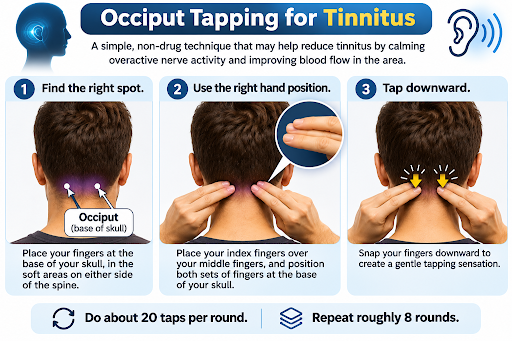
Some report temporary relief. If you decide to try it, be gentle and stop if it causes discomfort.
My advice is to start by finding out what’s causing your tinnitus rather than simply trying to drown out the noise. A thorough hearing evaluation can uncover problems that may be treatable, while newer options like Lenire offer hope when the cause isn’t so clear. And don’t overlook your overall health. Better sleep, good nutrition, and addressing metabolic problems may help, even if they don’t eliminate the ringing.
GoldCare membership gives you the opportunity to schedule appointments with clinicians who specialize in caring for patients with long COVID and vaccine-related injuries.
Have a question you’d like Dr. Gold to address in a future article? Please submit it here.
The post Ask Dr. Gold: Parkinson’s Weight Loss, Tinnitus, and What Actually Works appeared first on The Gateway Pundit.