

This article originally appeared on Iran So Far Away and was republished with permission.
There is something deeply familiar about the latest attack on Iran’s reformists by Fars News, the media outlet affiliated with the Islamic Revolutionary Guard Corps.
Fars has accused reformists of helping Washington sustain its pressure campaign by publicly arguing that sanctions are hurting Iran, negotiations are necessary, nuclear concessions may eventually have to be made, and military escalation would be costly. Fars News contends that reformists are undermining Iran by signaling to Washington that U.S. pressure is working.
To anyone accustomed to the Islamic regime’s political theater, however, there is another way of looking at this spectacle.
The harder the IRGC attacks the reformists, the easier it becomes for those same reformists to present themselves abroad as courageous moderates standing against the regime’s darkest forces.
The denunciation itself becomes a credential. In Persian, there is an expression for this kind of political window-dressing: “ghahramaan-saazi,” or “hero manufacturing.”
This doesn’t mean every clash between reformists and hardliners is staged. They fight over social controls, over who gets the spoils, over tactics and turf. Lesser-known reformists, those on the lower rungs of the reformist hierarchy, have been known to be sidelined or even jailed, but none of that changes the core reality.
Reformism here isn’t an exit from the Khomeinist system; it’s a career path within it. Yet none of that changes the fundamental point that mainstream reformism arose from within the Islamic regime and works inside the system not to replace it, but to redirect its machinery toward their own factional interests, leveraging the system rather than dismantling it.
Western analysts of the Khomeinist political system have described reformists and other so-called modernizers as very much operating within the system, maintaining the continued existence of the Khomeinist regime.

That distinction is routinely blurred in the West, where the vocabulary of Tehran politics is translated into categories that are far more familiar than they are accurate.
The hardliners are treated as the Iranian equivalent of the political right, the reformists as a kind of liberal opposition, and every dispute between them as though it were a conventional democratic contest between competing visions of government. It simply is not.
The more important dividing line is often between those competing within the Islamic regime and those who question the legitimacy or continued existence of the system itself.
This is precisely where the reformist faction becomes so useful internationally. Hardliners tend to say what they mean in language that Western audiences find abrasive.
They speak openly about revolutionary ideology, military power, resistance, hostility toward Israel, distrust of the United States and the preservation of the revolutionary order.
They make relatively little effort to sound reassuring to Western ears. Whatever else may be said about them, Western governments generally understand whom they are dealing with.
The reformist performs a very different function. He speaks the language of negotiation, moderation, dialogue, engagement, civil society and mutual understanding. He knows how Western diplomats think, understands what vocabulary travels well through universities and think tanks, and instinctively recognizes the almost irresistible desire of Western governments to believe that somewhere inside the Islamic Republic there is a reasonable partner waiting to be strengthened.
The difference in tone can be enormous, but a difference in tone should not automatically be mistaken for a difference in ultimate political allegiance.
Indeed, the history of Iran’s nuclear diplomacy illustrates the point exceptionally well. The Joint Comprehensive Plan of Action was negotiated under Hassan Rouhani, with Foreign Minister Mohammad Javad Zarif becoming its most recognizable Iranian architect.
Zarif was extraordinarily effective in Western settings because he was everything an IRGC commander was not: polished, fluent in English, educated in the U.S., comfortable with Western journalists and diplomats, and capable of expressing Tehran’s interests in a vocabulary his interlocutors found familiar.
Yet Zarif was not negotiating against the Islamic regime. He was its foreign minister, acting on behalf of its government and within a negotiating process that ultimately required the political space permitted by Iran’s supreme leadership.
This should have been obvious, but the distinction became strangely difficult to maintain once Western policymakers became invested in the narrative of “moderates versus hardliners.”
Rouhani and Zarif came to represent an Iran with which the West could supposedly do business, while some Mullahs and the Revolutionary Guards represented the Iran that diplomacy was meant to contain.
The result was a political framework in which strengthening the reformists increasingly became synonymous with encouraging moderation in Iran itself, even though the people being described as moderates remained senior officials of the Islamic Republic.
Zarif’s history in American foreign-policy circles predates the JCPOA and helps explain why he became such an effective interlocutor.
During his years at the United Nations, he participated in unofficial and semi-official diplomacy with American officials and policy specialists, and in 2005 he took part in a dinner discussion on Iran’s nuclear program with former US nonproliferation official Robert Einhorn at an event sponsored by the International Crisis Group and hosted by its board member George Soros.
The important fact is that reformist and senior officials of the Khomeinist regime became adept at presenting the Islamic Republic to the West in a language the West wanted to hear.
Their value did not depend on any secret cabal; it lay in their talent for putting lipstick on a pig, making the same regime seem more reasonable, more polished, and easier for Western audiences to accept.
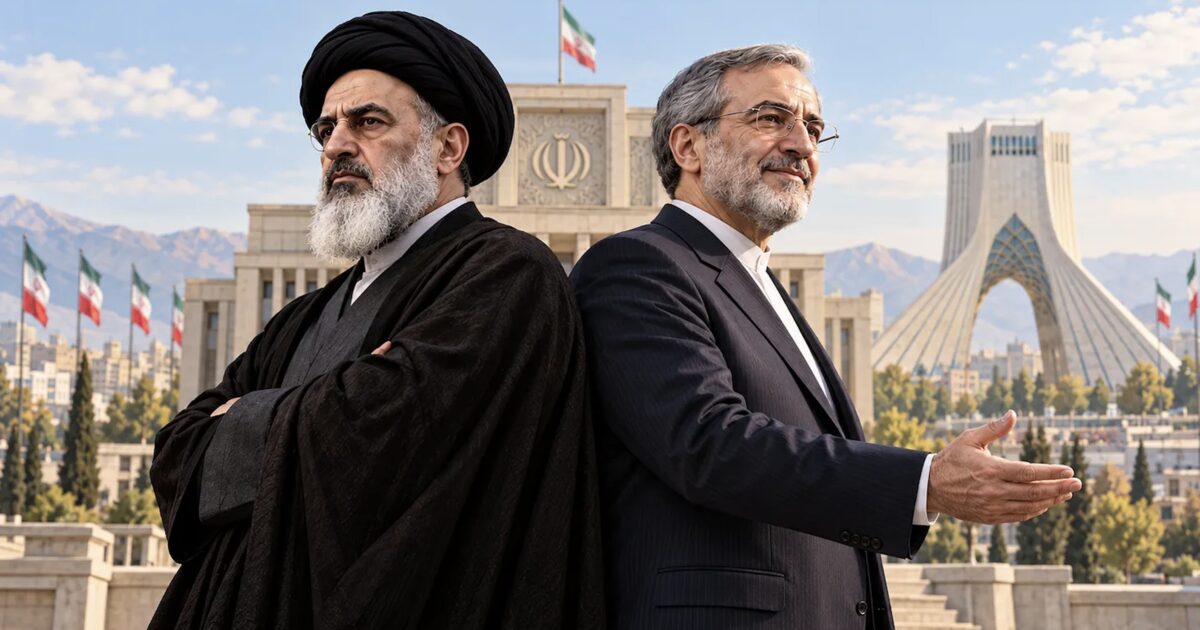
This isn’t a genuine contest over the country’s direction, but a division of roles. One side supplies the menace; the other supplies the reassurance.
The reformist doesn’t undo the hardliner; he refines the delivery, so the same system looks negotiable. What reads abroad as conflict works in practice as theater: The frightening extreme and the calming alternative, with the underlying order left untouched.
The Fars News commentary illustrates that division of roles almost perfectly.
Beneath the rhetoric, the argument is not over the survival of the Islamic Republic, but over how its interests should best be advanced: how Tehran should negotiate, how much leverage it should preserve, what concessions it might make, and how diplomacy should be balanced against military pressure.
As Iran International notes, the dispute is increasingly about the scope and conduct of negotiations, not about whether the regime itself should remain in place.
Those are important disagreements, but they are disagreements over the management of the Islamic Republic’s foreign policy. They should not automatically be confused with a struggle between the Islamic Republic and an opposition seeking an entirely different political order.
Instead of asking what Iranians outside the system want, Western policymakers too often reduce Iran to a contest among its own factions: Rouhani, Zarif, or Khatami versus the Revolutionary Guards.
Once the debate is limited to which insider should prevail, the Islamic Republic has already succeeded in setting the boundaries of the conversation and Western imagination.
The post Manufacturing the Opposition: Iran’s Reformist Ruse appeared first on The Gateway Pundit.