
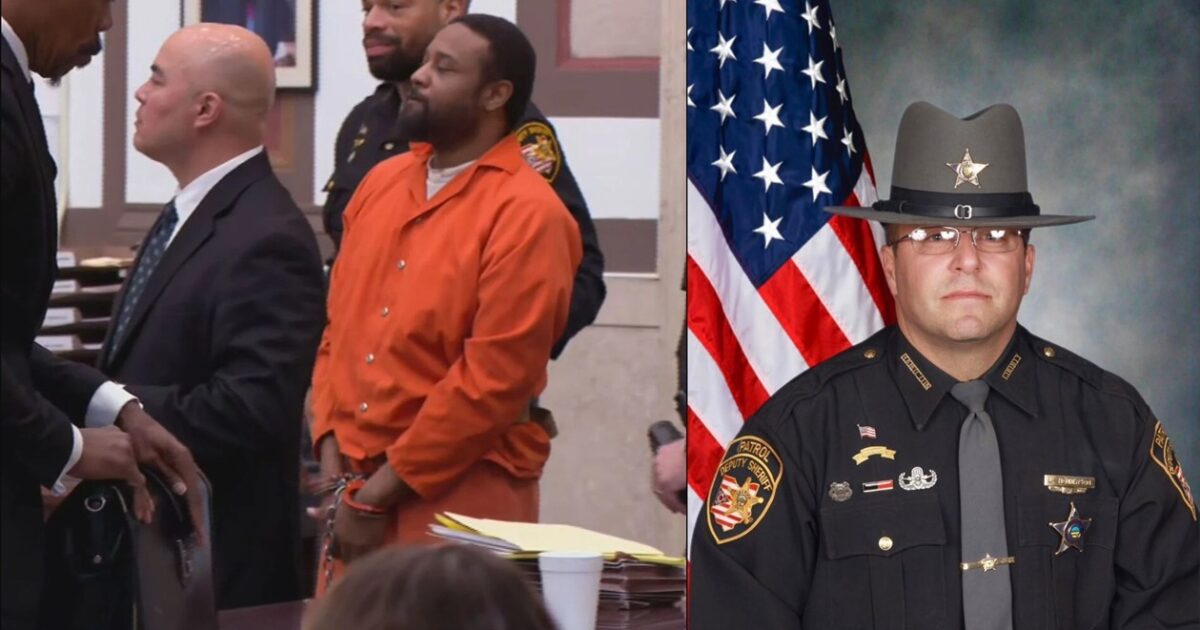

The murder trial of Rodney Hinton Jr., the Cincinnati father accused of killing a sheriff’s deputy the day after his own son was fatally shot by police, is set to begin October 5, 2026.
The case has revived a debate that has simmered since the fentanyl overdose death of George Floyd in 2020: Media coverage of high-profile police shootings has consistently misrepresented the underlying data, exacerbating public outrage and distorting Americans’ understanding of whom police shoot and why.
The Cincinnati case now heading to trial shows how quickly a single shooting can generate a false narrative of its own. On May 1, 2025, Cincinnati police located a stolen Kia Telluride at an East Price Hill apartment complex with four occupants inside, including 18-year-old Ryan Hinton.
As officers approached, all four fled on foot. Hinton was carrying a handgun with an extended magazine, and the officer who shot him said Hinton pointed it at him. From the time officers reached the car until shots were fired, only six seconds elapsed. The Hamilton County prosecutor later ruled the shooting legally justified and declined to charge the officer.
The next day, Hinton’s father, Rodney Hinton Jr., watched police body-camera footage of the shooting and then deliberately drove his car into Hamilton County Sheriff’s Deputy Larry Henderson, killing him. Henderson had no connection to the shooting. He worked for a different agency than the officer who shot Ryan Hinton and was assigned to an unrelated traffic detail for a University of Cincinnati graduation ceremony.
Social media posts nonetheless circulated false claims that Rodney Hinton Jr. had killed the same officer who shot his son. The social media framing was that a black man had been pushed beyond his limit by police repeatedly shooting innocent black people and had taken revenge on his son’s killer. Some posts went so far as to call him a hero.
The reality is that his son was armed and involved in a crime when he was shot. Hinton then planned and carried out the murder of an innocent man.
Prosecutors initially sought the death penalty; that was dropped in January 2026 after evaluators found Hinton has a qualifying serious mental illness. Hinton has pleaded not guilty by reason of insanity and faces trial on murder and felonious assault charges, with a maximum sentence of life without parole if convicted.
Today’s media and social media distortions are an extension of what happened during the unrest following Floyd’s fentanyl overdose death. Many Americans came to believe that police killed hundreds of unarmed black men each week. Mainstream media coverage often reinforced that impression by framing individual shootings as evidence of a systemic pattern without providing the base-rate data needed to evaluate the claim.
The Washington Post’s Fatal Force database, the source most commonly cited by researchers, tells a different story from the one that has taken hold in the public consciousness. On average, police fatally shoot fewer than 60 unarmed people per year, the majority of whom are white.
Unarmed” is meant to indicate that the person had no weapon of any kind. However, audits of the database have found that some people coded as “unarmed” were confronting officers with vehicles, rocks, or other improvised weapons. A City Journal audit found that of 118 black people listed as “unarmed” and fatally shot between 2016 and 2022, 51 were attacking police or civilians at the time, while several others were making threatening movements.
Therefore, the label has not reliably reflected its own definition, much less indicated that a shooting was unjustified.
Each shooting is investigated separately to determine whether the officer’s use of deadly force was legally justified.
Recent incidents involving anti-ICE protesters allegedly attempting to run down federal law-enforcement agents illustrate the distinction. A person using a vehicle as a weapon may not be carrying a gun or knife but can still pose a deadly threat.
Police fatally shoot roughly 1,000 civilians a year in the United States. As of the June 2019 update, the Washington Post database recorded 14 unarmed black suspects and 25 unarmed white suspects for that year. The database excludes deaths not caused by shooting, such as Floyd’s.
In 2024, police fatally shot 1,173 people, the highest annual total since the Post began tracking the data in 2015. By the Post’s own accounting, about half of those shot and killed by police were white.
Therefore, it is clearly untrue that police shoot hundreds of unarmed black people each week. The data show that police fatally shot an average of about 23 people per week in 2024, only about 2% of whom were unarmed. Most of the unarmed people shot were white.
Mainstream media outlets and anti-police activists point out that Black Americans account for about 23% of people shot by police, compared with roughly 14% of the population. This is then framed as evidence that black Americans are killed at more than twice the rate of white Americans.
They cite this disparity as evidence of police bias, systemic racism, and police specifically targeting and killing black people. However, this ignores the fact that black Americans commit a disproportionate share of violent crimes and have more police encounters, increasing the likelihood that they will be involved in police shootings.
According to FBI Uniform Crime Reporting data, white individuals accounted for 69.4% of all arrests in 2019, while black individuals accounted for 26.6%. For violent crime specifically, white arrestees made up 59.1% of the total, putting black arrestees at roughly 39%, nearly three times their share of the population. For murder specifically, 51.3% of adults arrested were black and 45.7% were white.
Having said all of this, the other point that the liberals and anti-police activists miss is that each case must be adjudicated on its own merits and evidence, not based on a general impression of policing or broad opinions about racism in the United States.
In this case, a suspect armed with a gun was shot by police, and his father murdered an innocent man. No data analysis or framing is needed. Under U.S. law, the case should be adjudicated based on the evidence.
The post False Police-Shooting Narrative Turns Accused Deputy Killer Into a Hero appeared first on The Gateway Pundit.