

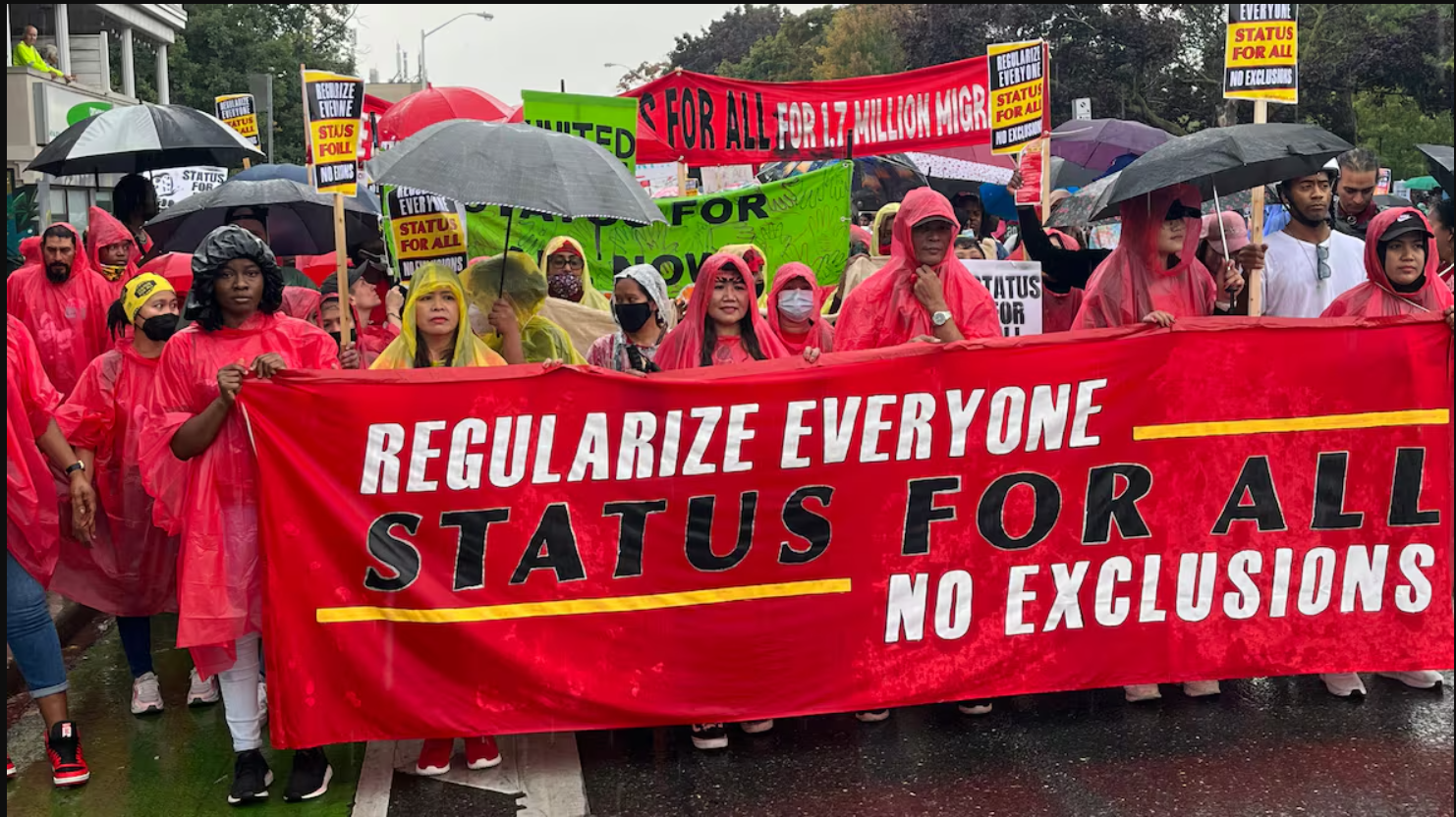
From Canada to Europe, citizens are pushing back against migration because of concerns over crime, welfare dependency, and the broader fiscal burden. Photo courtesy of CBC.
A Canadian group is being called racist for pushing back against immigration, but they have legitimate grounds to believe the country would benefit from mass deportations.
Statistics Canada’s “immigrant generation” measure shows 44% of Canadians are first- or second-generation, either immigrants themselves or Canadian-born children of at least one immigrant parent. This includes 26.4% first generation and 17.6% second generation, with the combined share projected to reach 49.8% to 54.3% by 2041. Canada was home to 755 mosques as of December 2024; no reliably sourced count exists for 30 years earlier for comparison.
Immigration, Refugees and Citizenship Canada (IRCC) reports the incidence of social assistance among immigrants is stable at 6%, below the national average of 8%. On crime, no Canadian government or think-tank source, left or right, publishes data broken down by immigrant origin the way Denmark and Sweden do.
That 6% figure comes from Statistics Canada’s “immigrant” category, which does not include non-permanent residents, a separate classification covering work and study permit holders and asylum claimants. Once granted status, Protected Persons claimed social assistance at 39% in their first year in Canada, declining to 20% after ten years. These rates are several times higher than the general immigrant figure but are reported under a separate legal category rather than folded into it.
Labor force data shows similar variation by origin. Most immigrant groups in Canada have female participation rates between 60% and 80%, but Statistics Canada research found that women from Pakistan fall below 50%. A peer-reviewed study using linked Statistics Canada survey data found that women from the Middle East and North Africa have the lowest labor force participation of any immigrant group, an effect the researchers attributed to source-country gender norms rather than religion specifically.
More broadly, racialized immigrant women had a 77% labor force participation rate and a 12% unemployment rate in 2021, the lowest and highest rates, respectively, among all immigrant groups measured.
The Fraser Institute estimated Canada’s net fiscal burden from immigration at over $6,000 per capita in 2005/06, totaling $16.3 to $23.6 billion that year.
This is where the Dominion Society of Canada comes in. The nationalist group is drawing national attention for a plan to deport millions of people. Its rise is part of a wider anti-immigration pattern of mobilization spreading across Western democracies, including a loosely organized protest movement against asylum accommodation in Ireland that has grown steadily since 2022.
The Dominion Society has scheduled a national conference, “DomCon 2026,” for August 29 in the Hamilton, Ontario, area. The group was founded on July 1, 2025, by Daniel Tyrie, a former executive director of the People’s Party of Canada, along with Greg Wycliffe and Ken Jones. It is registered as a non-profit corporation with an office in Ottawa. Members can join for a $25 fee.
The group advocates what it calls “remigration” of an estimated five million to nine million people, a category that includes temporary foreign workers, permanent residents, and people born in Canada to non-Canadian citizen parents.
The Canadian Anti-Hate Network reported that Dominion Society had roughly 1,600 registered members in October 2025, and by summer 2026, Dominion Society itself claimed roughly 3,000 members while raising hundreds of thousands of dollars. Evan Balgord, who directs the Canadian Anti-Hate Network, told CBC that Dominion Society likely has thousands of members, mostly young white men and boys.
On August 4, 2026, the Hamilton Anti-Racism Resource Centre and the Hamilton Centre for Civic Inclusion published an open letter advising local businesses against renting space to Dominion Society and calling on elected officials to denounce the group.
Mayor Andrea Horwath followed on August 12 by sending her own letters to venues, writing that “the Dominion Society’s own website identifies ‘remigration’ as a central objective of its movement, and the Canadian Anti-Hate Network has identified the organization as part of Canada’s broader white-nationalist movement.” Horwath said she was not asking venues to act outside their own policies, only to have “full context” before booking.
The City of Hamilton confirmed it would not rent municipal facilities to Dominion Society, and the venue originally booked for the conference canceled its reservation, though Hamilton police did not disclose the venue’s identity or reason. Dominion Society responded by telling CBC it is keeping DomCon’s exact location secret so its members are not targeted by opponents.
Part of the pressure on venues stemmed from the conference’s announced speaker lineup. DomCon 2026 advertised Austrian activist Martin Sellner as a speaker; Sellner is permanently banned from entering the United Kingdom over his role in far-right and identitarian activism, and Canadian officials did not say publicly whether he would be admitted to Canada. When Sellner responded to a Dominion Society post promoting his appearance by writing “I hope they let me in,” Dominion Society chair Daniel Tyrie said in an emailed response that the group’s legal team could not find a reason he would be barred.
The City of Hamilton also confirmed that bylaw officers have been monitoring Dominion Society promotional posters placed on public property, and Hamilton police said they were preparing a plan to address any risks, disruptions, or criminal activity connected to the event.
Criticism of the group has come from across the political spectrum. Jason Kenney, a former Conservative federal immigration minister and Alberta premier, publicly called Dominion Society founder Daniel Tyrie “racist” after Tyrie gave an interview to the outlet Juno News advocating remigration. Kenney said Tyrie’s group is “not just opposed to ‘mass immigration,’ but to ANY immigration,” pointing to the group’s own website call for a “total moratorium on all immigration for a minimum of 10 years” and “the forcible deportation of every legal permanent resident in Canada.” Kenney separately told CBC’s Front Burner that failing to draw a line against the group risks “mainstreaming or destigmatizing outright racist sentiments.”
Barbara Perry, who directs the Centre on Hate, Bias and Extremism at Ontario Tech University, said the group also promotes the “great replacement” conspiracy theory. The Canadian Anti-Hate Network’s own report on the group notes that Dominion Society’s platform exempts what it calls “heritage Canadians” from deportation — a category the Network says the group has defined, inconsistently, as exclusively white — while applying its deportation plan to legal permanent residents and naturalized citizens who fall outside that category.
Canada’s federal deportation numbers, separate from any activist platform, have also risen. The Canada Border Services Agency removed 23,160 people in 2025, the highest single-year total in the agency’s history, with removals reaching roughly 400 people a week by March 2026. More than half of those removals occurred in Quebec, where the Migrant Justice Clinic in Montreal has described a sharp escalation in enforcement tactics.
In Ireland, anti-immigration organizing has followed a different trajectory but a similar arc of growth. The Garda Síochána recorded 307 anti-migrant protests in 2022 and at least 169 more through August 2023, concentrated in Dublin neighborhoods including East Wall, Ballymun, Finglas and Drimnagh, as well as towns such as Mullingar and Roscrea. Protesters have organized under slogans including “Ireland is Full,” and demonstrations have at times escalated into arson attacks on buildings intended to house asylum seekers, including incidents in Coolock in 2024.
The International Protection Accommodation Service reported roughly 33,250 people in its accommodation system at the end of 2025, a 450 percent increase since 2021, even as new asylum applications declined. Ireland’s government passed the International Protection Bill 2026, intended to speed asylum decisions and extend the residency requirement for citizenship to five years; the law drew criticism from UNHCR Ireland, Nasc and the Irish Refugee Council.
A June 2026 knife attack in Belfast triggered several nights of disorder in Belfast, Portadown, Derry and Newtownabbey, and protesters on both sides of the border adopted the slogan “Irish Lives Matter,” which the Police Service of Northern Ireland recorded as a hate incident after it appeared at the Kennedy Centre on Belfast’s Falls Road.
Security analysts note that the open border under the Common Travel Area allows demonstrations in Belfast and Dublin to draw overlapping supporter bases, and that 90 percent of asylum seekers entering the Republic of Ireland may have first traveled through Northern Ireland.
Global Project Against Hate and Extremism has tracked more than a dozen active nationalist and anti-immigration groups in Ireland, including the Irish Freedom Party and the National Party, and traces the movement’s growth to the period following COVID-19 pandemic restrictions, when anti-lockdown organizing networks pivoted toward opposition to asylum accommodation.
Similar organizations have formed in other countries. In Italy, the Identitarian Movement organized the first Remigration Summit in Milan in May 2025, drawing about 400 attendees. A follow-up gathering in Portugal in May 2026 drew more than 500 activists and influencers, including former U.S. Border Patrol chief Gregory Bovino and American Renaissance editor Jared Taylor.
In Spain, the Canadian Anti-Hate Network has noted parallels between Dominion Society and groups such as Núcleo Nacional, which is under investigation for a hate crime after sharing anti-immigration content online. In Canada itself, Dominion Society shares overlapping membership with Second Sons Canada, a group that conducts firearms training, mixed martial arts, and military-style drills under the supervision of veterans.
In the United States, the Federation for American Immigration Reform, founded in 1979, remains the country’s largest and longest-running immigration-restriction organization. The Southern Poverty Law Center classifies it as a hate group with ties to white supremacist figures, a designation FAIR disputes.
Government data from several European countries shows migrant-origin populations overrepresented in violent crime, rape convictions, and welfare receipt. In Denmark, non-Western immigrants and their descendants, 8.9% of the population, account for 25.4% of violent crime convictions, with the highest individual rates recorded among men born in Lebanon, Somalia, Morocco, Syria, and Pakistan, all Muslim-majority countries.
In Sweden, 58% of men convicted of rape or attempted rape over a recent five-year period were born abroad. Brå, Sweden’s national crime-prevention agency, found that individuals of North African origin carry the highest relative risk of criminal suspicion of any origin group, at 4.7 times the rate of native Swedes.
On welfare, 45% of German unemployment-benefit recipients are non-citizens, while a Dutch study using official CBS microdata found that non-Western immigrants have relatively high reliance on non-employment benefit categories, tied mainly to lower average incomes.
The post Anti-Immigration Movements Gain Ground in Canada, Ireland and Beyond appeared first on The Gateway Pundit.