

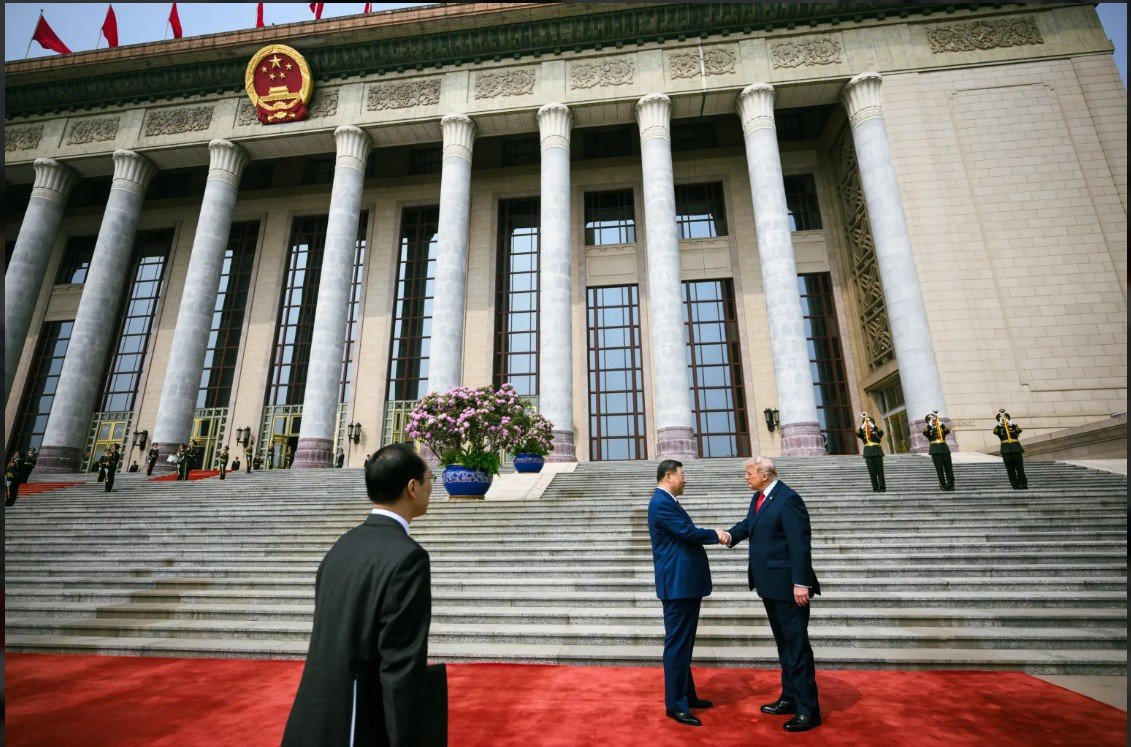
Mainstream media are claiming that President Trump somehow lost in his meeting with Chinese leader Xi Jinping and was kowtowing or subordinate to him.
One point they continue to raise is that when reporters asked whether Trump had asked China for help with Iran, he was dismissive and quickly moved on. They interpret this as Trump having asked and been rebuffed, which is not the case.
China had already offered to help, and before the meeting, both President Trump and Secretary of State Marco Rubio had publicly stated they were not going to ask for Chinese assistance.
When reporters pressed Rubio on what Trump had asked Xi regarding Iran, Rubio was explicit: “He didn’t ask him for anything. I mean, we’re not asking for China’s help. We don’t need their help.”
Trump’s own response to reporters, “we don’t need favors,” was consistent with that position, not evidence of a failed request.
Xi had already volunteered during the summit that he was willing to help, telling Trump, “If I can be of any help at all, I would like to be of help.”
There is also a very good reason President Trump did not ask China for help with Iran. China has a long history of making agreements and failing to keep them.
During Trump’s first term, the Phase One trade deal, signed in January 2020, required China to purchase an additional $200 billion in U.S. goods and services over two years. According to the Peterson Institute for International Economics, China fell more than 40 percent short of its target in the first year alone.
Trump is not foolish enough to believe China can be relied upon to deliver on its promises.
Beyond that, Trump tends to focus intensely on the issue directly in front of him rather than being pulled into tangential matters. He was in China primarily to discuss trade, tariffs, and investment issues that have a direct and concrete impact on the American economy and people’s daily lives.
He did not raise the Uyghur genocide, human rights, democracy, or freedom of religion because those were not the purpose of the visit.
The same pattern of deliberate, singular focus was evident the week before, when reporters asked Trump whether economic strain on Americans, particularly rising gas prices, was affecting his negotiations with Iran.
Trump told reporters: “Not even a little bit. The only thing that matters when I’m talking about Iran, they can’t have a nuclear weapon. I don’t think about Americans’ financial situation. I don’t think about anybody. I think about one thing, we cannot let Iran have a nuclear weapon. That’s all.”
As Snopes noted, the quote was widely truncated and stripped of context. Trump was not saying he is indifferent to the American economy. He was saying he refused to let domestic political pressure push him into a bad deal on Iran’s nuclear program.
Another reason not to enlist China’s help is that Beijing has little meaningful record of successfully brokering peace agreements. It frequently presents itself as a global peacemaker, but its actual record is limited. Analysts at the China US Focus describe Beijing’s approach as “quasi-mediation diplomacy,” heavy on rhetoric and symbolic gestures, light on costly commitments. China points to the 2023 Saudi-Iran normalization as its signature diplomatic success, but its other attempts, including in Afghanistan, Sudan, Yemen, Ukraine, and the Israeli-Palestinian conflict, have produced no concrete results.
By contrast, Trump has claimed to have helped end nine conflicts, including the wars or standoffs involving Israel and Iran, India and Pakistan, Armenia and Azerbaijan, Cambodia and Thailand, the Democratic Republic of Congo and Rwanda, Serbia and Kosovo, Egypt and Ethiopia, Israel and Hamas, and the ongoing effort toward Ukraine and Russia, with Axios reporting the count has grown steadily since he returned to office.
The Abraham Accords from his first term have been revitalized and expanded, with Kazakhstan joining in November 2025 and additional countries in discussions. Only Trump was able to move Arab and Muslim states toward normalization with Israel on that scale.
The operational realities of the Iran conflict further illustrate why China is largely irrelevant here. The UAE and Saudi Arabia carried out covert offensive military strikes against Iran, the first known offensive actions by Gulf states against Tehran, while Saudi Arabia and Kuwait conducted additional covert strikes on Iranian-backed paramilitary targets in Iraq. The UAE has also expressed openness to deeper military engagement with the United States and Israel, at a minimum, to end Iran’s ability to disrupt the Strait of Hormuz.
This is the kind of direct coalition engagement Beijing has never demonstrated an ability to organize or lead.
Despite leading the BRICS bloc, which includes Iran as a full member since 2024, despite being the world’s largest oil importer and Iran’s largest oil customer, purchasing upward of 90 percent of its exported crude and generating roughly $31 billion annually for Tehran, and despite serving as Russia’s principal financial backer, Beijing has proven unable to meaningfully influence the conflict.
BRICS itself failed to issue a joint statement on the 2026 Iran war, deadlocked because both Iran and the UAE, on opposing sides of the conflict, are members. In Iran’s hour of greatest need, neither Russia nor China came to its aid in a forceful or kinetic way. As the Carnegie Endowment noted, Beijing calculated it made far more sense to sit on the sidelines than waste resources on a conflict it could not control.
Xi told Trump China would not provide military equipment to Iran, but stated it intended to keep buying Iranian oil, making Beijing a financial lifeline for Tehran, not a partner in pressuring it. There is little reason for the United States to depend on China for help in a conflict where Gulf partners are already engaged operationally and China remains on the sidelines.
The post Trump Rightly Dismissive of China’s Offer to Help Resolve Iran Conflict appeared first on The Gateway Pundit.