

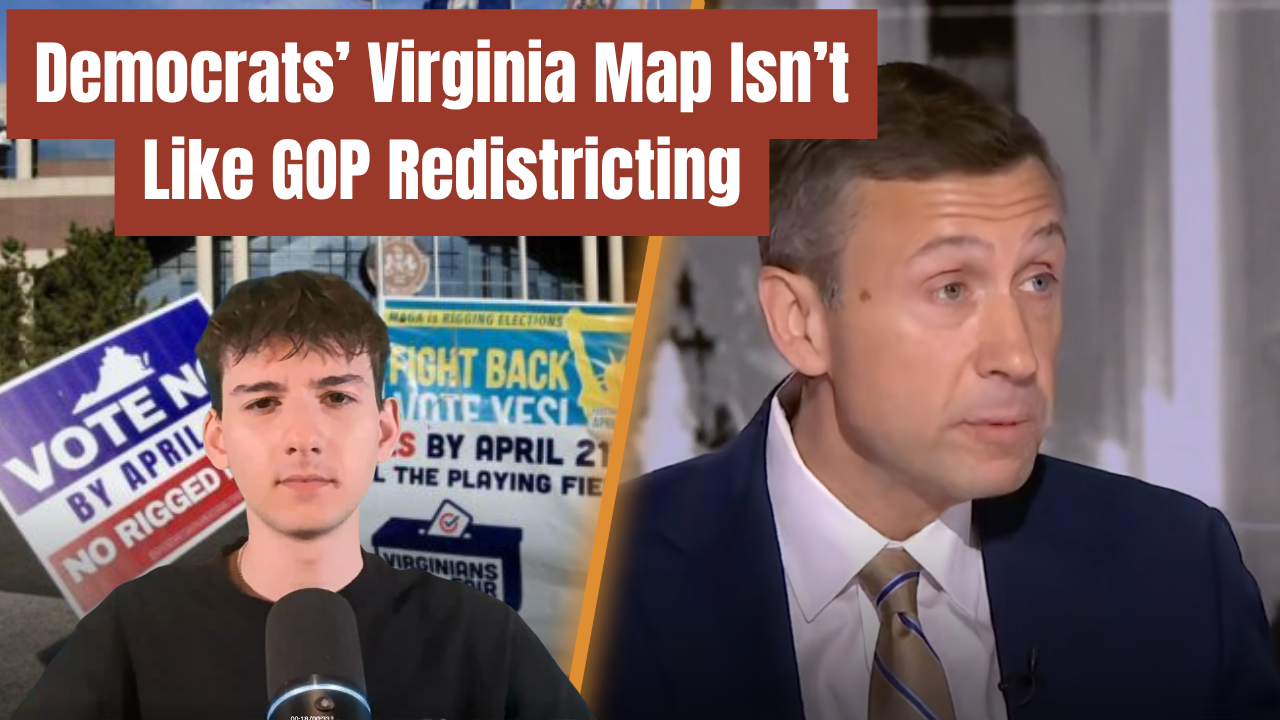
In an interview on MSNOW, DNC Chairman Ken Martin attempted to defend Democrats’ latest redistricting effort in Virginia by framing it as a justified response to Republicans.
But his argument overlooked the most important fact: what happened in Virginia is fundamentally different from typical redistricting fights in solid red or solid blue states.
Virginia voters narrowly approved a redistricting referendum, 51.5% to 48.6%, allowing the Democrat-controlled legislature to move forward with a new congressional map.
The map could give Democrats as many as 10 of Virginia’s 11 congressional seats, a dramatic shift from the current 6–5 Democrat advantage.
A Virginia judge later blocked certification of the vote, ruling that the measure violated the state constitution and that the ballot language was misleading. The state is expected to appeal.
That is not a minor technical dispute. It is the core of the issue.
Virginia already had a redistricting process built around a nonpartisan commission. The state’s current congressional map was not some extreme Republican gerrymander.
It reflected Virginia’s closely divided electorate, where Democrats and Republicans both have real political strength. That is why the delegation sat near the middle, not at a 10–1 partisan split.
The new Democrat-backed map would take a competitive swing state and turn its congressional delegation into something that looks nothing like the actual electorate.
Republicans redistrict in states like Texas and Florida because those states are already reliably Republican. Democrats do the same in places like New York and California.
Redistricting is political, and both parties use it. But redrawing a swing state mid-cycle to create a near-total partisan advantage crosses a much more serious line.
Martin did not address that distinction. Instead, he mocked Republicans and claimed Democrats were simply “fighting back.”
He argued that Republicans started the redistricting fight and that Democrats were not “bringing a pencil to a knife fight.”
That may be effective television rhetoric, but it does not answer the basic question: why should a swing state with a nearly balanced electorate be turned into a map where one party could control almost every congressional seat?
Democrats cannot claim to be defending democracy while pushing a map that could reduce Republican representation in Virginia to one seat out of 11.
They cannot insist redistricting is dangerous when Republicans do it, then celebrate when Democrats use the same tool more aggressively in a state where the consequences are far greater.
The hypocrisy is obvious.
A fair map in a swing state should reflect the voters who live there. Virginia is not California. It is not New York. It is not a deep-blue state where Democrats naturally dominate every region.
Rather, Virginia is a competitive state, and its congressional map should reflect that competition.
Instead, Democrats pushed a plan that could wipe out most Republican representation while calling it democracy.
That is the real story from Martin’s MSNOW interview. The DNC chairman did not defend fairness.
He defended a political maneuver designed to give Democrats more seats, more control, and a better chance of taking back the House.
Republicans should call it exactly what it is: a Democrat power grab in one of the most important swing states in the country.
The post Why the Virginia Redistricting Scheme Is Not Even Close to GOP Redistricting appeared first on The Gateway Pundit.