

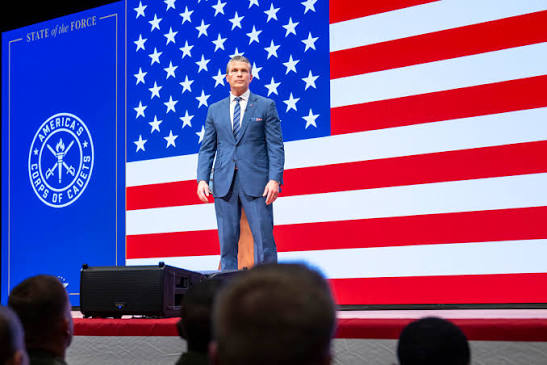
Secretary of War Pete Hegseth announced on September 30 that the Pentagon will create an Autonomous Warfare Command, known as AUTOWARCOM. He made the announcement in his State of the Force address to active-duty E-6s (staff sergeants, technical sergeants, and petty officers first class) and O-3s (captains and Navy lieutenants) at Marine Corps Base Quantico.
AUTOWARCOM will be the military’s 12th combatant command, a unified command led by a four-star officer that directs forces from multiple services. It will have “service-like authorities, built to scale autonomous and robotic capabilities across the joint force,” with a portfolio covering drones, artificial intelligence, and command and control systems.
A memo released after the speech sets October 1, 2027, as the target date to establish the command, contingent on congressional approval.
The command was one of six initiatives Hegseth unveiled in the speech. The others are America’s Corps of Cadets, FORTRESS America, the Next Great American Base, an Office of Religious Affairs, and Project Meridian, a study of future warfare that Elon Musk will co-direct.
AUTOWARCOM builds on an office Hegseth created three months earlier. A June 29 memo established the Direct Reporting Portfolio Manager for Unmanned Systems (DRPM-UxS) as the department’s single joint integrator for unmanned and autonomous system programs. The office reports to Deputy Secretary Stephen Feinberg and oversees how the military develops, buys, fields, and sustains unmanned systems in the air, on the ground, and at sea.
The Defense Autonomous Warfare Group and Joint Interagency Task Force 401 became deputy offices under it. The office also inherits the $53.6 billion allocated for autonomous drone platforms in the department’s budget request.
Hegseth directed DRPM-UxS to lead Project Agincourt, an interim effort to prepare the way for the command. The project takes its name from the Battle of Agincourt in 1415, where English longbowmen helped defeat a larger French army of armored knights, and Hegseth mimed a bow and arrow as he announced it.
Defense Innovation Unit Director Owen West will serve as chief executive officer of DRPM-UxS, and Navy SEAL Senior Chief Max Strasiser will serve as chief operating officer. Strasiser was the first enlisted SEAL to graduate from Navy Test Pilot School. The office has 30 days to submit a plan of action and milestones for Hegseth’s approval. It will also coordinate with Congress on required legislation.
Under Agincourt, the office will prototype a model Hegseth called “warfighting acquisition.” It pairs operators with entrepreneurs in rapid adaptation cycles and moves decisions and funding closer to frontline units.
Hegseth said Ukraine showed that no single type of drone wins wars and that a system built to adapt is what matters. The department states that its Drone Dominance program has delivered thousands of robotic systems to the Middle East in support of Operation Epic Fury.
Congress has already moved toward a similar command. The Senate Armed Services Committee’s fiscal 2027 National Defense Authorization Act would permit a Robotic and Autonomous Systems Combatant Command led by a four-star general. The committee passed the bill 18–9 in June.
The Air & Space Forces Association opposed the provision in a July 6 letter to committee Chairman Jack Reed. The association argued that the command would complicate the development, acquisition, and operational use of the services’ unmanned systems.
Two other initiatives include drone components. FORTRESS America calls for installations to generate their own power and for bases to be protected against cyberattacks, sabotage, and drones. The Next Great American Base will be a new installation for 15,000 to 25,000 troops, with autonomous systems and air defenses. States will compete to host it.
Hegseth also commissioned Project Meridian, a 120-day study co-directed by Musk, Anduril co-founder Palmer Luckey, and former House Speaker Newt Gingrich. The commissioning memo names artificial intelligence, autonomy, directed energy, robotics, and biotechnology as fields that will change warfare. It directs the study to identify the capabilities troops will need and propose ways to develop, test, and field them.
Pentagon Chief Technology Officer Emil Michael will commission the project through a partner organization the memo does not name. Findings are due January 28, 2027, in a public report with a classified annex.
“The best forecasters of future conflict do not solely reside inside the Pentagon,” Hegseth said. Musk’s SpaceX is a Pentagon contractor, and Luckey’s Anduril builds autonomous weapons for the military. Meridian is Musk’s first official role advising the administration since his public feud with Trump after leaving DOGE.
The post Hegseth Announces Autonomous Warfare Command, Taps Musk for Future-Warfare Study appeared first on The Gateway Pundit.