

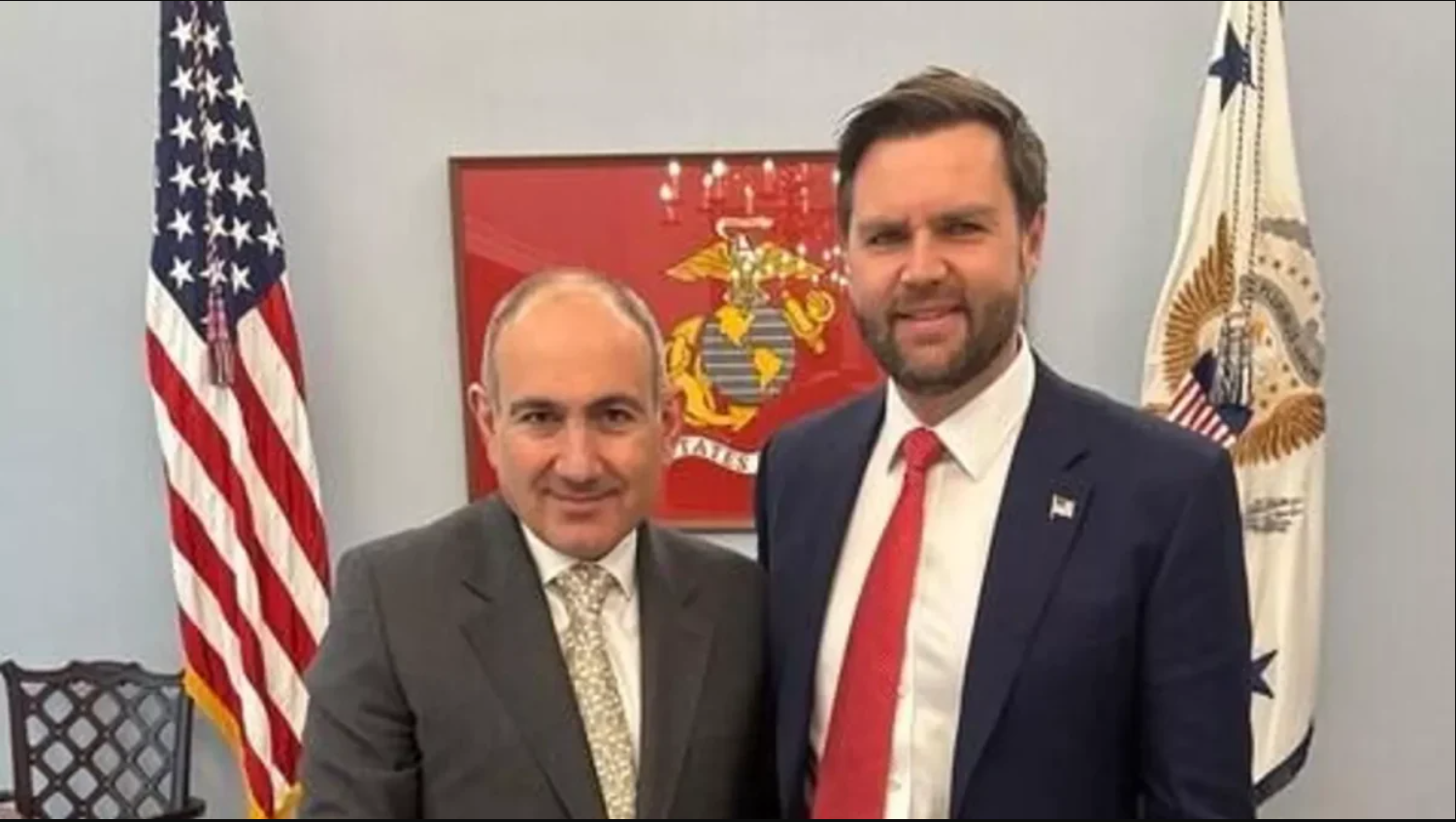
President Trump brokered a 2025 peace framework between Armenia and Azerbaijan that is advancing a U.S.-controlled trade corridor along Iran’s northern border, drawing Armenia toward Washington and expanding American influence in a region long dominated by Russia and Iran.
Recent developments show the project moving from diplomacy into physical implementation, with bipartisan support in Congress for finishing the deal before Trump leaves office.
Armenia and Azerbaijan agreed on September 9, 2026, to delimit their border from north to south, including sections where the Trump Route for International Peace and Prosperity, or TRIPP, will pass.
The announcement followed a September 8 meeting in Baku between U.S. Chargé d’Affaires in Armenia David Allen and Azerbaijani Deputy Foreign Minister Elnur Mammadov. They discussed implementing TRIPP and creating a company to manage construction along the route. That week, Azerbaijani Foreign Minister Jeyhun Bayramov confirmed that Baku is monitoring Armenia’s constitutional amendment process, which Azerbaijan has made a precondition for signing the final peace agreement.
The peace process follows decades of conflict over Nagorno-Karabakh, an ethnically Armenian enclave internationally recognized as Azerbaijani territory. Azerbaijan recaptured the territory in a September 2023 military offensive, ending three decades of Armenian separatist control and prompting the exodus of more than 100,000 ethnic Armenians.
On August 8, 2025, Armenian Prime Minister Nikol Pashinyan and Azerbaijani President Ilham Aliyev signed a joint declaration at the White House, mediated by President Trump. They agreed to end the fighting, open trade and travel, establish diplomatic relations, and build TRIPP, a 44-kilometer rail and road corridor through Armenia’s Syunik province connecting mainland Azerbaijan with its Nakhchivan exclave. Under the agreement, the United States would lease the route for 99 years with exclusive development rights, while the corridor would remain under Armenian jurisdiction.
Following the signing, Pashinyan and Aliyev jointly nominated Trump for the Nobel Peace Prize in an application submitted to the Norwegian Nobel Committee. Aliyev separately said Trump “really deserves” the prize.
TRIPP moved toward implementation on September 1, 2026, when its official Facebook page launched in Armenia. The page was created jointly by Armenia’s Ministry of Foreign Affairs and the U.S. Department of State and is managed by the Armenian ministry and the U.S. Embassy in Armenia.
On September 9, Rep. Abraham Hamadeh of Arizona, a member of the House Armed Services Committee, predicted a final Armenia-Azerbaijan peace agreement well before the end of Trump’s term. He said TRIPP could bind the countries together politically and economically while opening the South Caucasus to greater Western trade and investment. Hamadeh visited Azerbaijan in June and Armenia in August, meeting with both countries’ leaders and emerging as an active congressional interlocutor in the region.
TRIPP runs along Iran’s northern border. Iran has opposed the corridor and similar arrangements, viewing them as threats to its transit role, influence in Armenia, and border with Armenia. Tehran once called the region, historically known as Zangezur and including Syunik, its own “red line.” It also increased its military presence near the border during years of negotiations.
U.S. engagement accelerated from February 9 to 11, when Vice President JD Vance became the first sitting U.S. vice president to visit Armenia and the highest-ranking American to visit either country. In Yerevan, Vance met with Pashinyan, signed a civil nuclear agreement, and visited the Tsitsernakaberd Armenian Genocide Memorial with his wife, Usha. The following day, he met Aliyev at the Zagulba Presidential Residence in Baku and signed a strategic partnership charter covering trade, energy, and security.
The State Department said the trip was intended to advance Trump’s peace initiative and promote TRIPP. In Armenia, Vance announced up to $9 billion in nuclear investment and an $11 million reconnaissance drone sale. The corridor is projected to reduce cargo transit between Asia and Europe from 18 days to 12 along the Middle Corridor.
Iran’s ambassador to Armenia announced in February 2026 that the two countries planned to form a comprehensive strategic partnership within the year. That month, the United States and Israel launched strikes on Iran, beginning a conflict that remains ongoing. Iran and Armenia continued discussing a long-term cooperation agreement.
On July 8, Iranian President Masoud Pezeshkian reportedly warned Pashinyan that “extra-regional powers,” referring to the United States and TRIPP, must not be allowed to interfere in Armenian-Iranian relations.
Azerbaijan is uniquely positioned as the only country sharing substantial borders with both Russia and Iran, placing it between two of Washington’s principal geopolitical challengers. The 2025 U.S. National Security Strategy identifies the South Caucasus as a critical Eurasian node and Azerbaijan’s location on Iran’s northwestern flank as a strategic asset. The Heritage Foundation has identified U.S. interests in the region as limiting Russian and Iranian influence, securing energy routes to global markets, and preserving American access to the Caspian Sea and Central Asia.
The Baku-Tbilisi-Ceyhan pipeline, which passes through Azerbaijan and Georgia, supplies approximately 40 percent of Israel’s oil annually. Iran and Russia have deepened regional coordination through military technology transfers connected to Russia’s war in Ukraine. Russia has also pursued the International North-South Transport Corridor linking Russia with Iran and India.
Armenia and Georgia are the region’s two historically Christian states, distinct from Muslim-majority Azerbaijan, and each has followed a different course with Washington, Moscow, and Tehran. Armenia was once considered the Kremlin’s outpost in the South Caucasus, hosting a Russian military base in Gyumri and belonging to the Russia-led Collective Security Treaty Organization and Eurasian Economic Union. Trade between Russia and Armenia grew by more than 300 percent from 2021 to 2024, and an estimated 2.5 million to 3 million ethnic Armenians live in Russia, with remittances providing significant revenue for Armenia.
Since Azerbaijan’s 2023 recapture of Nagorno-Karabakh, which Armenia considered inadequately supported by Russia, Armenia has been exploring EU membership and moving toward the West. Pashinyan’s Civil Contract party was returned to power with roughly 50 percent of the vote in parliamentary elections held June 7, 2026, extending his mandate to continue that course.
Armenia’s break with Moscow has unfolded in stages rather than through a single formal act. It froze its CSTO participation in February 2024 and stopped funding the organization. Later that year, Pashinyan called withdrawal the “next logical step.” By November 2025, Armenia’s National Assembly speaker said the country had “effectively withdrawn”, although the deputy foreign minister said no formal mandate had been issued. As of April 2026, Armenia had not formally withdrawn but had ended all participation, including joint military exercises, and Russia told Armenia to stop claiming membership. Russian border guards have left parts of Armenia’s border with Azerbaijan but remain stationed along its borders with Turkey and Iran.
The fate of Russia’s Gyumri base is similarly unresolved. Pashinyan has said the base is not “vital” to Armenia’s security, and Putin told reporters on September 2, 2026, that Russia would withdraw “tomorrow” if Armenia no longer wants it there. As of this writing the base remains operational, and Jamestown’s most recent analysis describes a Pashinyan-Putin meeting the same day as “frosty,” with no resolution in sight.
Georgia’s relationship with Washington has moved in the opposite direction. The U.S.-Georgia strategic partnership was effectively frozen in November 2024 amid democratic backsliding under the ruling Georgian Dream party and the government’s suspension of its EU accession process. Georgia’s attempts to reset relations with the Trump administration have been unsuccessful. TRIPP’s passage through Armenia is also expected to reduce Georgia’s importance as the region’s traditional east-west transit corridor.
Georgia describes its foreign policy as “sovereign and pragmatic”. It maintains limited economic engagement with Russia, expands relations with China and Arab states, and continues positioning itself within the Middle Corridor.
Neither Armenia nor Azerbaijan has signed the final peace agreement. Baku says it will not sign until Armenia removes claims to Azerbaijani territory from its constitution. Armenia is preparing constitutional changes, but they require approval in a referendum scheduled for 2027.
TRIPP has triggered domestic opposition in Armenia over the 99-year U.S. lease. Russia has been sidelined in the peace process and is watching the expansion of U.S. influence in the region with unease.
The post Trump’s Incremental Wins in the South Caucasus Could Sideline Iran and Russia appeared first on The Gateway Pundit.