
Since returning to office, President Trump has imposed tariffs on dozens of countries, from close allies like the European Union and Japan to rivals like China, using both emergency economic powers and long-standing trade statutes. The stated goals range from demanding reductions in trade tariffs and restrictions imposed by trading partners to curbing fentanyl trafficking and illegal migration, correcting trade imbalances, forcing supply chains away from forced labor, breaking U.S. dependence on China, and reshoring manufacturing as a matter of national security.
Most of these countries did not retaliate, and several negotiated new trade terms that gave the United States a better deal. Mexico declined to retaliate, with roughly 85% of its exports shielded under the USMCA. The European Union, Japan, South Korea, and the United Kingdom negotiated reduced rates rather than imposing counter-tariffs. India responded to its 50% tariff with domestic tax cuts, while Brazil, hit with a 25% Section 301 tariff, pursued World Trade Organization consultations and established a domestic credit line for affected firms.
According to PBS, “Canada and China are the only countries that have retaliated against Trump in his trade war.” Both have engaged in tariff-for-tariff conflict with the United States over the past year and a half.
China’s retaliation has been more aggressive, although Beijing has also proven more open to negotiation. After Washington raised tariffs on Chinese goods, Beijing responded with tariffs of 10% to 15% on U.S. agricultural products, including soybeans. In October 2025, China also announced sweeping export controls on rare earths, gallium, germanium, antimony, and graphite. The United States depends on these materials for chips, magnets, and batteries.
Trump responded by threatening an additional 100% tariff on Chinese goods. The standoff eased at the Trump-Xi summit, where China agreed to suspend its rare-earth controls for one year, resume large-scale soybean purchases, and remove the retaliatory tariffs it had imposed since March 2025. In exchange, the United States halved its fentanyl-related tariff and extended exclusions.
Chinese commentators have since warned that Beijing could revive both the soybean freeze and the rare-earth restrictions if new Section 301 investigations proceed. Therefore, the truce remains fragile rather than settled.
One might expect China, a U.S. rival, to escalate a trade war, but Canada is the United States’ closest ally. Yet long before the trade war began, Canada imposed tariffs on U.S. imports.
Dairy products, including milk, cheese, and butter, faced over-quota tariffs of roughly 200% to 300% once shipments exceeded the quota volumes negotiated under the USMCA. This structure dated back to NAFTA and was reaffirmed under the USMCA in 2020. Poultry and eggs, including chicken and turkey, were subject to the same tariff-rate-quota system, with similarly steep over-quota rates protecting Canada’s supply-management boards.
Clothing and apparel faced Canada’s baseline nondiscriminatory tariff, averaging around 18%. Cultural products were also taxed to protect Canadian content, with rates of up to about 18% on broadcasting and publishing and between 6% and 16% on foreign-produced films and recordings. Imported spirits carried a per-liter, excise-style tariff of roughly CAD $2.87 plus 2.5% of their value. Grain products also faced some tariffs, although the rates were generally lower than those imposed on dairy and poultry.
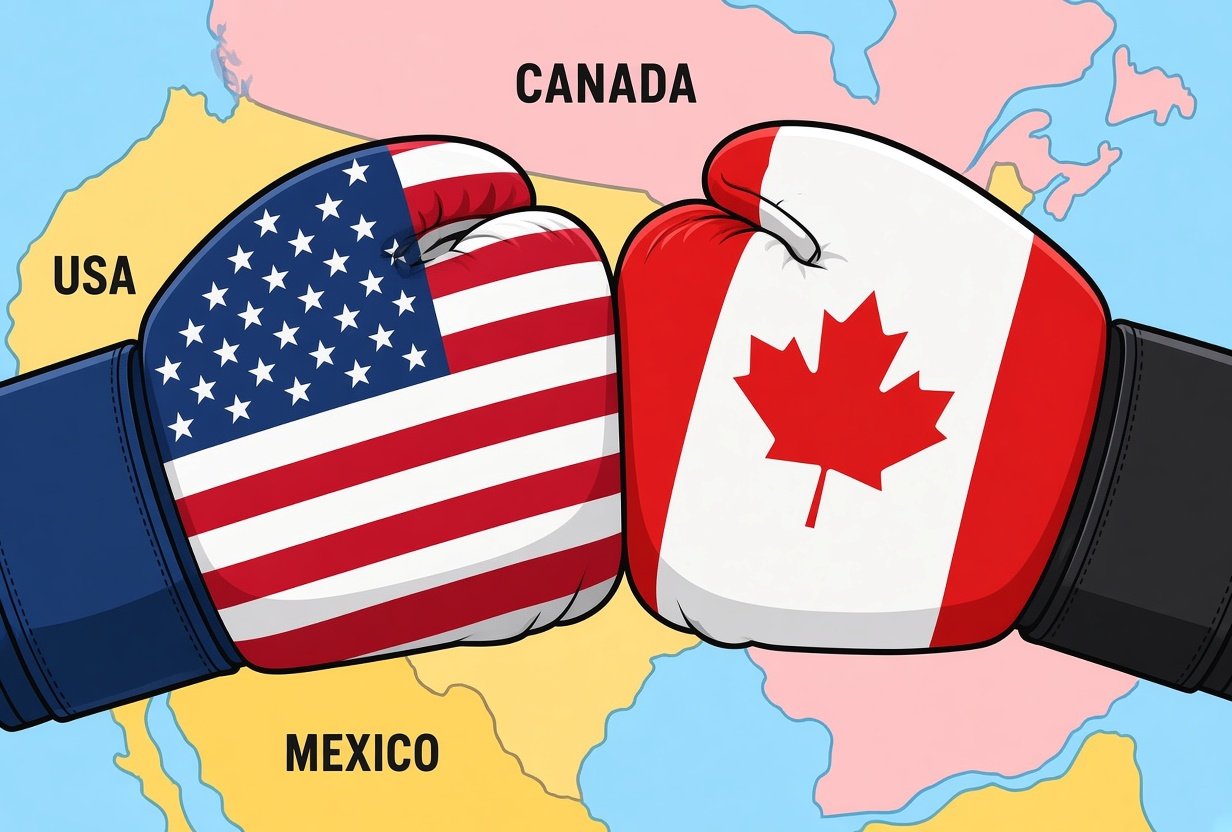
That changed in April 2025, when Washington imposed a 25% Section 232 tariff on all imported vehicles, including the non-U.S. content of Canadian-built cars. Canada responded with its own 25% tariff on U.S. vehicles.
The standoff escalated from there. After the United States imposed 50% tariffs on roughly $20 billion worth of Canadian goods, Prime Minister Mark Carney suspended trade talks, recalled Canadian negotiators to Ottawa, and announced that Canada “will match the U.S.’ new tariffs dollar for dollar.” Those retaliatory measures take effect on September 8.
This is the clearest case of a G7 economy choosing confrontation over compromise with its largest trading partner, and the numbers suggest that Canada is the weaker party in that confrontation.
A good example of how much more dependent Canada is on the United States than vice versa is Ontario Premier Doug Ford’s repeated threat to weaponize electricity exports. Ford has vowed to cut power exports to New York, Michigan, and Minnesota, the states directly supplied by his province’s grid. He declared that he would do it “with a smile on my face” and that Ontario would not give Washington “a grain of sand.”
Ford briefly carried out part of the threat in March 2025 by imposing a 25% surcharge on electricity sold to those three states. He backed down after Trump threatened to double tariffs on Canadian steel and aluminum in response. Ford renewed the threat in August 2026 as the current standoff escalated.
Ford’s threats are backed by nothing. Canadian electricity accounts for less than 1% of total U.S. electricity consumption nationally. The U.S. Energy Information Administration puts net dependence at roughly 0.2% of total U.S. consumption. According to Penn State energy professor Seth Blumsack, “U.S. electricity operators likely have enough short-term capacity to replace any Canadian power that is withheld or becomes too expensive to buy.”
The United States buys Canadian power because of its price, not because of scarcity. Ontario and Quebec have a surplus of low-cost hydroelectric and nuclear capacity, while parts of the U.S. Northeast have some of the highest power prices in the country. Consequently, it is often cheaper for border states to import Canadian electricity during peak summer and winter demand than to operate their most expensive backup plants. If that supply were cut off, those states would sometimes pay more per kilowatt-hour, but they would not go dark.
Canada, meanwhile, has nowhere else to send that power. Canada exports electricity exclusively to one market, the United States. Its transmission grid runs north to south into the United States rather than east to west between Canadian provinces, leaving no alternative buyer for the surplus power. Electricity exports were worth roughly $3.3 billion to Canada in 2025. Threatening to cut them off is a threat to forfeit that revenue outright, not a source of meaningful pressure on the U.S. electricity supply.
Canada holds the switch, but flipping it costs Canada money while costing the United States a rounding error.
Canada’s overall trade figures tell a similar story. Canada sent 68% of its merchandise exports to the United States in the first half of 2026, according to Statistics Canada data. That was down from 76% in 2024 but still represented an overwhelming share. Other full-year data put the figure as high as 73%.
Exports to the United States alone account for roughly 17% to 18% of Canada’s entire GDP, while total Canada-U.S. trade represents nearly one-third of Canada’s economy. By comparison, trade with Canada accounts for roughly 3% of U.S. GDP.
The United States sent only about 15.4% of its total exports to Canada in 2025, the lowest share on record for either Canada or Mexico as a leading U.S. export market. Canada also runs a trade surplus with the United States. In 2025, the United States imported $453.6 billion in goods from Canada while exporting $426.3 billion to it. Consequently, Canada has considerably more to lose in absolute terms from a breakdown in the relationship.
Foreign investment follows the same logic, and Canada’s own government says so openly. Ottawa’s pitch to foreign investors emphasizes what it calls preferential, “virtually tariff-free access” to the U.S. and Mexican markets under CUSMA. Together, those countries represent a market of more than $30 trillion in GDP, far larger than the Canadian market alone.
The United States is by far Canada’s largest source of foreign direct investment (FDI), accounting for 46% of Canada’s total inbound FDI stock, worth $452 billion as of 2023. Much of the capital flowing into Canadian factories and supply chains is not chasing Canadian consumers. It is chasing tariff-free access to the American market through Canada. If a prolonged trade war undermines that access, Canada risks losing the advantage that made it attractive to investors in the first place.
The Bank of Canada has outlined how costly a prolonged confrontation could be. Under its severe-tariff scenario, the central bank projected that Canadian GDP could fall roughly 5% below a no-tariff baseline. Business investment could decline by nearly 12% by early 2026, while unemployment could rise as export-sensitive industries, including autos, lumber, steel, agriculture, and energy, shed jobs.
Canada avoided the worst of that outcome only because roughly 90% of its goods exports remain exempt under CUSMA. The Bank of Canada now assumes that U.S. tariffs are permanent rather than a temporary shock that can simply be waited out. Even so, the government’s spring 2026 economic update acknowledged that tariffs contributed to declines in Canadian goods exports, reduced business investment, and job losses concentrated in Ontario and Quebec. Meanwhile, nominal exports to the United States ended 2025 nearly 17% below their December 2024 level.
Carney’s dollar-for-dollar pledge escalates a fight in which Canada holds the weaker hand by every measure of dependency, including export concentration, the trade balance, and the relative size of the markets each country stands to lose.
China can exchange tariff threats with Washington because it controls chokepoints in rare earths and critical minerals that the United States cannot easily replace. Canada holds no comparable leverage over the U.S. economy. It mainly controls how much pain its own exporters, autoworkers, and mortgage holders will absorb as the standoff continues.
The post Canada’s Tariff Retaliation: They Need Us More Than We Need Them appeared first on The Gateway Pundit.